Table of Contents
- Why Verifying Appliance Repair Certification Matters
- What Appliance Repair Certification Actually Means
- How to Verify Appliance Technician Certification Online
- Step 1: Ask for Credentials Upfront, in Writing
- Step 2: Verify EPA Section 608 Certification the Right Way
- Step 3: Verify With the Issuing Organization Directly
- Step 4: Handle Credentials That Are Not in a Public Directory
- Step 5: Confirm Identity at the Door
- Step 6: Check Insurance and Business Registration
- How to Check Appliance Repair License Requirements
- Why Licensing and Certification Are Not the Same Check
- Step 1: Identify Which Agency Regulates the Work in Your Area
- Step 2: Search the License Database
- Step 3: Check Local Requirements
- Step 4: Ask the Company Which Licenses It Holds
- Step 5: Understand What Happens When Licensing Is Not Required
- A Consumer-Ready Verification Checklist
- Questions to Ask an Appliance Repair Company
- What a Manufacturer-Authorized Appliance Repair Technician Should Have
- Red Flags: How to Spot Credential Fraud and Unqualified Technicians
- Frequently Asked Questions
Last Updated: October 21, 2026
Why Verifying Appliance Repair Certification Matters
When your refrigerator stops cooling or your washer won’t drain, you need a qualified technician, not just someone with a truck and a toolbox, and you should verify appliance repair certification before hiring.
Anyone can claim to be an appliance repair expert. Without verification, you risk repairs that don’t stick, voided warranties, or damage to your appliance.
Verifying appliance repair certification protects you in three ways: it ensures training in your specific appliance type, confirms safety protocols (especially refrigerant handling), and gives you recourse if something goes wrong.
This guide walks you through how to verify appliance repair certification before you let anyone near your appliances.
What Appliance Repair Certification Actually Means
Appliance repair certification proves a technician has completed formal training and passed an exam in appliance service and repair. It’s not the same as a license, training, or manufacturer authorization, understanding the difference helps you ask the right questions.
Certification vs. Licensing vs. Training
Certification is a credential earned after passing a test, showing competency in a specific skill such as EPA refrigerant handling or washing machine repair.
Training is the education itself, a course or apprenticeship. It leads to certification or licensing, but completing it doesn’t automatically mean the person is certified or licensed.
Manufacturer authorization means the brand has approved the technician to service their products.
Common Types of Appliance Repair Credentials
Several organizations issue appliance repair certifications. Here are the most common ones:
EPA Section 608 Certification is the most important one. Federal law requires it for any technician who handles refrigerants, covering safe handling, recovery, and recycling in refrigerators and air conditioning systems (the EPA). Without it, a technician cannot legally work on cooling systems.
NASTeC (North American Technician Excellence) certification covers a broad range of appliances, with exams testing diagnostics, repair, and safety. NATE focuses specifically on HVAC and refrigeration; NATE-certified technicians often work on refrigeration components in appliances.
Manufacturer-specific certifications come directly from brands like Whirlpool, LG, Samsung, and GE, requiring brand-specific training. State licensing varies by location; if your state requires it, ask for the license number and verify it with your state’s licensing board.
How to Verify Appliance Technician Certification Online
Verifying credentials takes 15 to 30 minutes and can save you hundreds of dollars in callbacks, voided warranties, and repeat repairs. Verify at the source, the issuing organization’s own records, not a photo of a certificate or a website badge.
Step 1: Ask for Credentials Upfront, in Writing
Before you schedule, ask: “Which specific certifications do your technicians hold, and what are the certification numbers and expiration dates?” Vague answers like “we’re fully certified” are not answers.
Step 2: Verify EPA Section 608 Certification the Right Way
If the repair involves a refrigerator, freezer, wine cooler, dehumidifier, or any sealed refrigeration system, the technician must hold EPA Section 608 certification under the Clean Air Act, federal law, not a nice-to-have. Don’t search the EPA’s SNAP website, which lists refrigerant substitutes and does not verify technicians. The EPA publishes no single public lookup tool; certification is issued through EPA-approved programs, each keeping its own records.
To verify:
- Ask which EPA-approved certifying organization issued the credential and for the certification number.
- Contact that organization for written confirmation the individual holds a current Section 608 credential and at which level (Type I, II, III, or Universal).
- Confirm the level matches the work: Type I covers small appliances, Type II high-pressure systems, Type III low-pressure systems, and Universal all three. Household refrigerator work generally requires at least Type I; a Type I-only technician should not work on central air conditioning.
- Check expiration or recertification status with the issuer.
A technician who says “the EPA lists me” but cannot name the organization that issued the credential is a red flag. The EPA approves certifying programs; it does not hand out the cards itself.
Step 3: Verify With the Issuing Organization Directly
The most reliable verification is a direct check with whoever issued the credential, not what the technician tells you or a screenshot, which is easy to alter.
For manufacturer certifications (Whirlpool, LG, Samsung, GE, Bosch, Sub-Zero, and others):
- Go to the brand’s official website and find the “Find a Service Center,” “Authorized Service Provider,” or “Locate a Dealer” tool.
- Enter your ZIP code and confirm the company appears on the official list.
- Call the brand’s customer support line to confirm the company is authorized for your model and whether your repair is covered under the manufacturer’s warranty through that provider.
For trade certifications:
- Identify the issuing organization from the credential name.
- Use the organization’s online verification or directory tool if one exists.
- If no public tool exists, call or email customer service for written confirmation of the individual’s status, credential level, and expiration date.
- Save the confirmation email, it is your record if a dispute arises later.
For state licensing:
- Go to your state’s professional licensing board or Department of Labor website.
- Search by the individual’s name and by the company name.
- Confirm the license status is active and in good standing.
- Check the disciplinary action and complaint history tabs, if available.
State professional licensing board directory
Step 4: Handle Credentials That Are Not in a Public Directory
Many legitimate credentials, especially manufacturer authorizations and some trade certifications, aren’t publicly searchable. That doesn’t mean they’re fake; it means you need a different verification path.
- Ask the issuer to verify in writing. A short email confirming the individual’s name, credential, and status is usually enough.
- Ask the company for a letter of authorization. Manufacturer-authorized providers typically receive a formal authorization letter or certificate from the brand; ask to see a current copy.
- Cross-check the company against the brand’s locator. Even when the individual isn’t listed, the company usually is. If the company isn’t on the brand’s authorized list, the individual’s claim is suspect.
Keep a simple verification log: date, who you spoke with, what they confirmed, and any reference number. If a repair goes wrong, this log is useful evidence.
Step 5: Confirm Identity at the Door
Verification does not end on the phone. When the technician arrives:
- Match the technician’s name to the name the company gave you in writing.
- Ask for a company photo ID and compare it to the person in front of you.
- Confirm the company name on the vehicle or uniform matches the company you hired.
If the person at your door isn’t who the company said would arrive, call the company’s published number before letting them in, a basic safety step, not an accusation.
Step 6: Check Insurance and Business Registration
Certification proves technical competency, not that the business is legitimate or insured.
- Liability insurance: Ask for a certificate of insurance and call the insurer’s listed number to confirm the policy is active. A legitimate company won’t hesitate.
- Business registration: Ask for the company’s business license or registration number and verify it with your city or county business licensing office.
- Workers’ compensation: If the technician is injured in your home, workers’ comp matters. Ask whether the company carries it.
These checks take a few extra minutes and protect you from uninsured damage, warranty disputes, and fly-by-night operators.
How to Check Appliance Repair License Requirements
Appliance repair licensing is not uniform. Some states license repair businesses or technicians; others regulate only specific work like electrical connections or refrigerant handling; some don’t license appliance repair at all. Because rules vary by state, city, county, and appliance type, check the official source for your location.
Why Licensing and Certification Are Not the Same Check
A license is legal permission to operate, issued by a government agency. A certification is a voluntary or trade-issued credential proving competency. A technician can be certified but unlicensed, or licensed but not certified in a specialty. Check both, plus manufacturer authorization if warranty work is involved.
Certification answers “does this person know how to do the work?” Licensing answers “is this person legally allowed to do the work here?” You need both answers.
Step 1: Identify Which Agency Regulates the Work in Your Area
Start with your state’s professional licensing board or Department of Labor. Many publish an online license lookup searchable by name, company, or license number. Common patterns include:
- State contractor or trade licensing boards that regulate appliance repair businesses as a category of home services contractor.
- State electrical boards that regulate work involving hardwired connections, such as electric ranges, wall ovens, and dishwashers.
- State environmental or refrigerant programs that regulate refrigerant handling in addition to the federal EPA Section 608 requirement.
If you’re unsure which agency applies, call your state’s main licensing information line and describe the work: “I need to know whether appliance repair requires a state license, and which board handles it.” They will route you.
State professional licensing board directory
Step 2: Search the License Database
Once you know the agency, search by both the technician’s name and the company name. Confirm the license type matches the work, the status is active, the license is held by the company you’re hiring (not a similarly named business), the expiration date is in the future, and any disciplinary actions are disclosed.
Step 3: Check Local Requirements
Many cities and counties require a local business license, home-occupation permit, or contractor registration on top of state rules. Call your city or county business licensing office and ask whether an appliance repair company needs a local business license and whether there’s a separate home-service registration. The answers are usually quick and free.
Step 4: Ask the Company Which Licenses It Holds
Ask: “Which state and local licenses does your company hold, and what are the license numbers?” Legitimate companies keep this on hand. If the answer is “we don’t need one,” ask them to confirm in writing, then verify with the agency yourself, in some states that answer is correct; in others it’s a warning sign.
Step 5: Understand What Happens When Licensing Is Not Required
Where appliance repair isn’t licensed, certification and manufacturer authorization carry more weight as your primary evidence of competency. Focus on EPA Section 608 certification for refrigerant work, manufacturer authorization for warranty repairs, liability insurance and business registration, and written estimates, warranties, and complaint history.
“No license required” does not mean “no verification needed.” It means the burden shifts to you to confirm certification, insurance, and authorization directly.
A Consumer-Ready Verification Checklist
Use this checklist before you hire, and keep a copy with your repair records.
- Company provided the technician’s name and credential list in writing
- EPA Section 608 credential confirmed with the issuing organization (if refrigerant work is involved)
- Manufacturer authorization confirmed through the brand’s official locator or customer service line
This checklist covers what certification-focused pages often skip: insurance, written estimates, warranties, and complaint history. Together with credential verification, it tells you whether the person at your door is qualified, authorized, and accountable.
Questions to Ask an Appliance Repair Company
“Are your technicians certified? Which certifications do they hold?”
A good answer includes specific credential names and expiration dates.
This is non-negotiable. If they can’t prove it, don’t hire them.
“Are you authorized by my appliance’s manufacturer?”
Manufacturer authorization means they’ve met the brand’s standards.
“What’s your warranty on repairs?”
Confident technicians stand behind their work.
“Do you use genuine parts or aftermarket parts?”
Genuine parts are made by the appliance brand.
“Can you provide references or reviews from recent customers?”
Ask for names or links to verified reviews.
“How long have you been in business?”
Longevity matters.
What a Manufacturer-Authorized Appliance Repair Technician Should Have
A truly qualified technician carries specific credentials and documentation. Look for:
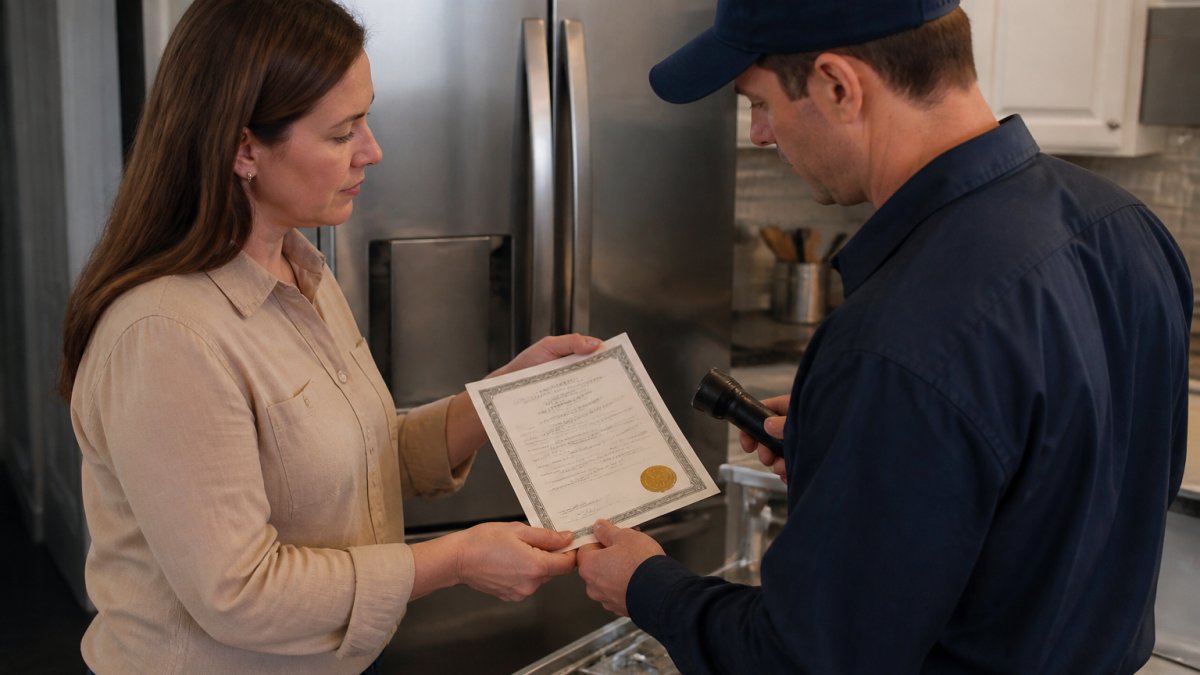
Certification card or certificate. A real certified technician carries proof, a wallet card, certificate, or documentation they can email. Ask to see it.
Business license. The company should have a business license from your city or county.
Insurance documentation. Professional repair companies carry liability insurance. Ask to see proof.
Valid ID. Any technician entering your home should have a company ID with their name, photo, and company name.
These items aren’t just paperwork, they prove the technician is legitimate and accountable.
Red Flags: How to Spot Credential Fraud and Unqualified Technicians
Some people claim credentials they don’t have.
They can’t provide certification numbers. Real certifications come with numbers.
Their certification has expired. Check expiration dates carefully. Expired credentials don’t count.
They won’t provide references. Ask for recent customer names or verified reviews.
They don’t carry liability insurance. Ask to see proof.
Frequently Asked Questions
How can I verify a technician’s appliance repair certification with the issuing organization?
Contact the certification body directly using contact information from their official website, never use numbers from the technician’s business card alone. For EPA Section 608 certification, search the EPA’s certified technician database. Ask for the technician’s certification number and credential issue date. Legitimate organizations maintain searchable databases or will confirm credentials by phone within 24 hours. If the issuing body cannot find a record, the credential is likely fraudulent.
What’s the difference between appliance repair certification, licensing, and manufacturer authorization?
Certification proves a technician passed a standardized exam in a specific skill area (like EPA refrigerant handling). Licensing is a government requirement in some states for certain repair work; it’s separate from certification. Manufacturer authorization means the brand has approved that technician or company to service their appliances and access proprietary parts and diagnostics. A technician may have certification but not manufacturer authorization, or vice versa. Always ask which credentials apply to your specific appliance and brand.
What questions should I ask an appliance repair company before hiring them?
Ask: Are your technicians certified, and in what areas? Do you hold manufacturer authorization for my appliance brand? What is your diagnostic fee, and does it apply to the repair cost if you fix it? Can you provide proof of certification and insurance? What warranty do you offer on repairs? How quickly can you schedule service? Request references or online reviews from recent customers. Honest companies answer all these questions directly without hesitation.
What are warning signs that an appliance repair technician’s credentials might be fake?
Red flags include: technicians who cannot name the issuing organization for their certification, credentials that cannot be verified through official databases, unusually low pricing with no diagnostic process, refusal to provide proof in writing, pressure to pay cash upfront, and claims of certification from organizations that don’t exist. Legitimate technicians carry physical credentials, list certification numbers, and welcome verification calls. If something feels off, contact the certification body directly before hiring.
When your appliance breaks down, you need a technician you can trust. Verifying appliance repair certification takes minutes but protects your home and your wallet. At Appliance Specialists of Oklahoma, our certified technicians carry EPA refrigerant certifications, manufacturer authorizations, and years of hands-on experience. We provide transparent pricing and stand behind every repair. [CTA: Book A Repair Now] and get your appliances working again with confidence.