Last Updated: October 23, 2026
Quick Summary
Same day appliance repair in Broken Arrow starts with one call placed early, because most same-day slots go to the first callers of the day. Give the dispatcher the appliance type and brand, the symptom, your address, and whether someone will be home.
- Text a photo of the model plate so dispatchers can identify the part family before the technician leaves.
- Have the model number, serial number, proof of purchase, clear access, and a working outlet ready before the visit.
- A dryer that takes two cycles to dry a load is often a vent problem, not a machine problem.
- An estimate should separate the diagnostic fee, parts, and labor so you see what you are paying for.
- Stop and call for help immediately if you notice a burning smell, smoke, sparking, or a gas smell.
Table of Contents
- How to Get Same Day Appliance Repair in Broken Arrow
- The Appliance Repair Appointment Checklist: What to Have Ready Before the Technician Arrives
- What Happens During a Same-Day Service Visit
- Same-Day Washer and Dryer Repair: What to Expect
- Appliance Repair Cost: How to Read an Estimate Before You Say Yes
- How to Choose an Appliance Repair Company You Can Trust
- Emergency Safety Guidance: When to Stop Troubleshooting and Call
- Service Areas and What to Do Next
- Frequently Asked Questions
How to Get Same Day Appliance Repair in Broken Arrow
Same day appliance repair Broken Arrow residents can count on starts with one call placed early. Most same-day slots go to the first callers of the day, and the households that get a technician out before dinner are the ones who booked before lunch.
Here is the honest part most guides skip: same-day service is a scheduling problem, not a repair problem. The repair itself often takes under an hour. Getting a van to your driveway on short notice is the hard part.
Why Most Same-Day Requests Fail in the Morning
The biggest mistake is waiting until the appliance has been broken for a day or two before calling. By then the morning dispatch board is full.
Three things sink a same-day request:
- Calling after the routes are set. Technicians leave with a planned route. Late callers get squeezed in only when a job finishes early.
- Vague symptom descriptions. “The washer is broken” tells a dispatcher nothing about parts to load. “The washer won’t drain and hums” tells them to bring a pump.
- No one home to grant access. A technician who arrives to a locked door burns a slot someone else needed.
We would rather give you a straight answer than a hopeful one. If the day is booked, we say so and offer the next morning.
How to Book: Call, Text, or Online
Booking is the easy part. Call during business hours Monday through Friday, text if you are at work and cannot talk, or book online and describe the symptom in the notes field.
Whichever route you choose, give the dispatcher four facts:
- The appliance type and brand
- What it is doing, or not doing
- Your address and whether someone will be home
- Whether the unit is still under a manufacturer warranty
That last one matters more than people realize. Warranty work often requires documentation, and knowing upfront prevents a second visit.
Text a photo of the model plate along with your request. Dispatchers can often identify the exact part family before the technician leaves the shop, which cuts diagnostic time on site.
The Appliance Repair Appointment Checklist: What to Have Ready Before the Technician Arrives
A little prep turns a diagnostic visit into a repair visit. The appliance repair appointment checklist below covers what to gather before the van pulls up. Most customers who do this get their appliance fixed in a single trip.
Model Number, Serial Number, and Proof of Purchase
Find the model and serial plate before the technician arrives. On refrigerators it is usually inside the door or behind the kick plate. On washers and dryers it is often on the lid, door frame, or back panel.
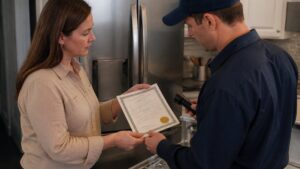
Have your proof of purchase handy if the appliance might still be under a manufacturer warranty. A receipt or order confirmation helps the technician document the visit properly and keeps your coverage intact.
Clear Access and a Working Outlet
Clear a path to the appliance. Pull boxes away from the washer, empty the cabinet under the sink if the dishwasher is involved, and make sure the outlet the unit plugs into actually works.
- Model and serial number written down or photographed
- Proof of purchase located
- Clear path to the appliance
That checklist takes five minutes and saves twenty.
What Happens During a Same-Day Service Visit
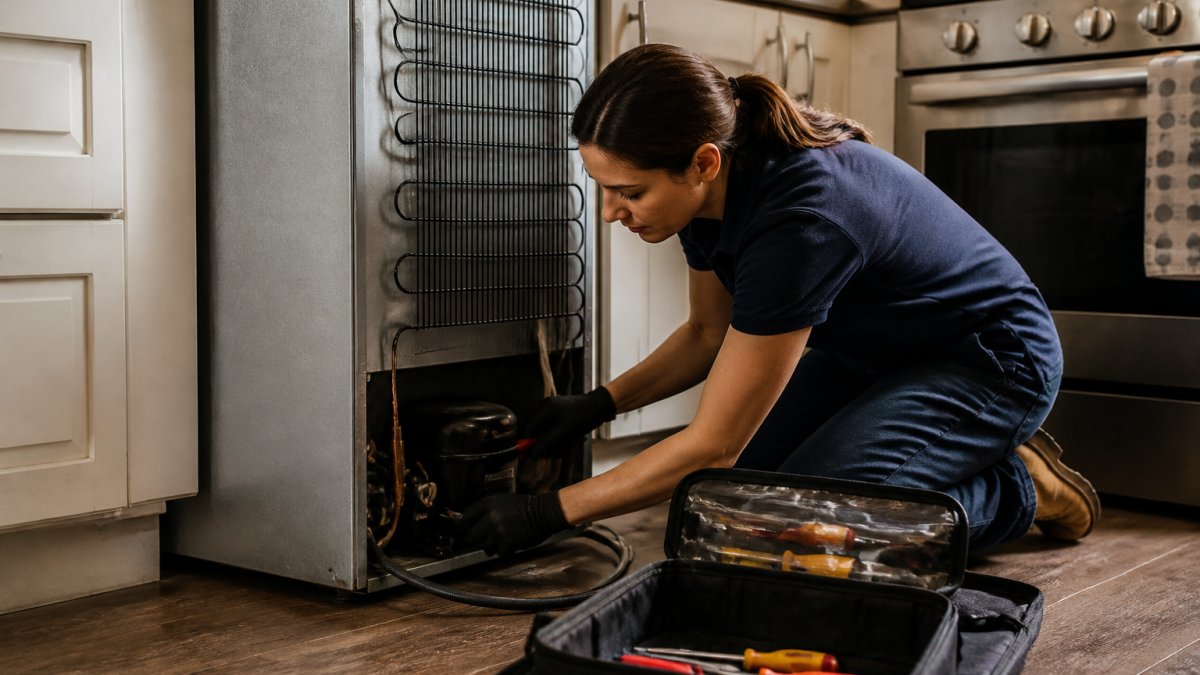
A same-day service visit follows a set sequence: intake, diagnosis, estimate, approval, repair, and test.
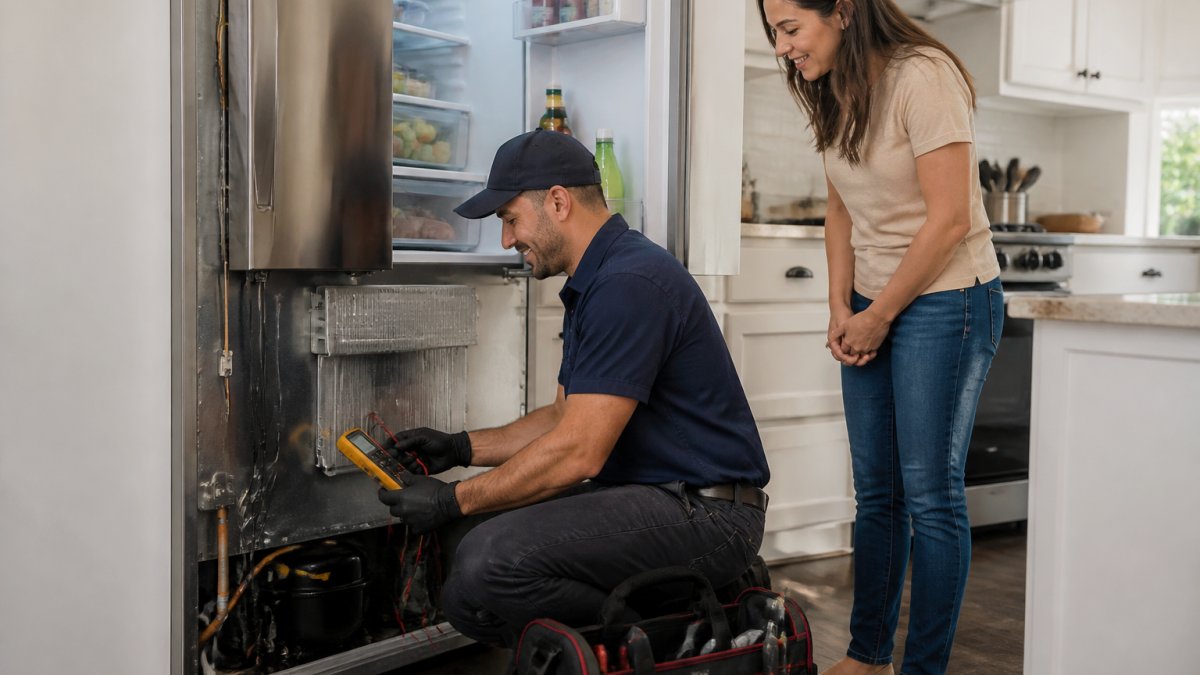
The technician starts by confirming the symptom with you, then runs diagnostics on the unit.
When a part has to be ordered, you get a clear timeline rather than a vague “sometime next week.”
Expect the technician to test the appliance with you watching and to explain what failed.
Same-Day Washer and Dryer Repair: What to Expect
Same-day washer and dryer repair usually comes down to a short list of common failures.
For washing machine repair, the technician typically checks the drain pump, lid switch, drive belt, and control board. Dryer repair calls center on the heating element, thermal fuse, vent blockage, and drum belt.
One thing we tell every customer: a dryer that takes two cycles to dry a load is often a vent problem, not a machine problem. Clearing a clogged vent is faster and cheaper than replacing parts, and it lowers fire risk at the same time.
If your unit is a front-load washer that smells or will not drain, mention that when you book. It changes which parts the technician loads.
Appliance Repair Cost: How to Read an Estimate Before You Say Yes
Appliance repair cost breaks into three parts: the diagnostic or service fee, parts, and labor. An estimate separates all three so you can see what you are actually paying for.
The Three Lines on a Repair Estimate
- Diagnostic or service fee. This is the charge to come out and identify the failure. Ask whether it is credited toward the repair if you approve the work.
- Parts. Ask whether the part is OEM (original equipment manufacturer) or aftermarket, whether it is new or remanufactured, and whether it is in stock locally or on order. A part on order can turn a one-visit repair into a two-visit repair, and the estimate should say so.
- Labor. Labor is usually quoted as a flat rate for the job rather than an hourly rate, which protects you if the repair runs long. Ask whether the labor figure includes testing and cleanup.
Ask these questions before approving work:
- Is the service fee waived if I proceed with the repair?
- Is the quoted price for parts and labor combined, or parts only?
- What warranty covers the repair, and for how long?
At Appliance Specialists of Oklahoma, we price transparently and put the numbers in front of you before we touch the appliance. You should never learn the real cost after the work is done. Current rates are listed on our pricing page, and we are glad to walk through them on the phone.
Be wary of any provider who quotes a low diagnostic fee and refuses to give a repair estimate in writing. That pattern usually means the real cost appears after the appliance is already apart on your floor.
What Actually Moves the Final Price
Two households with the same broken refrigerator can pay different amounts. The variables that matter most:
- Access. A unit in a tight cabinet or behind a stacked washer takes longer to service than one with clear clearance.
- Part availability. A common part on the van is cheaper and faster than a special-order control board.
- Fuel type and voltage. Gas ranges and 240-volt dryers carry safety and testing steps that electric models do not.
The Repair-vs-Replace Decision Framework
The 50/50 rule is a starting point: if the repair costs more than half the price of a comparable new appliance, replacement usually wins. But price alone is a blunt instrument. A more useful framework weighs four factors together:
- Age versus expected service life. Most major appliances are built for roughly 10 to 15 years of service. A repair at year four is usually worth it; a major repair at year 13 is usually not.
- Repair cost as a share of replacement. Under half the replacement price favors repair. Over half, and especially over two-thirds, favors replacement.
- Failure history. One failure in a year is normal. Three failures in a year, or the same failure twice, points to a unit that will keep costing you.
- Efficiency and safety. An old unit with a known safety recall, a failing seal, or energy costs well above a modern equivalent may be worth replacing even when the immediate repair is cheap.
Repair still makes sense when the appliance is young, the fix is a single common part, and the rest of the unit is sound. A refrigerator that needs a fan motor at year four is a repair. A fifteen-year-old refrigerator that needs a compressor and a control board is a replacement conversation.
We will give you that math honestly, even when it means talking ourselves out of a job.
How to Choose an Appliance Repair Company You Can Trust
Choosing an appliance repair company comes down to four checks: credentials, transparency, communication, and warranty. Get satisfactory answers to all four and you have found a keeper.
Ask directly:
- Are your technicians certified? Certified technicians carry training and accountability.
- Do you provide a written estimate before work begins? Verbal-only quotes are a red flag.
- What is your parts and labor warranty?
What most guides miss is the follow-up question: who actually shows up?
For warranty holders, confirm the company works with manufacturer warranty programs before booking. Going to the wrong shop can complicate a claim you were counting on.
Emergency Safety Guidance: When to Stop Troubleshooting and Call
Some appliance problems are not repair jobs. They are safety events, and no amount of troubleshooting is worth the risk.
Stop and call for help immediately if you notice:
- A burning smell, smoke, or scorch marks
- Sparking, buzzing, or a tripped breaker that will not reset
- A gas smell near a range or dryer
For a suspected gas leak, leave the home and call your gas utility from outside before calling anyone else. Do not flip switches on the way out.
Unplug the appliance only if you can reach the cord safely. Never pull a refrigerator or range away from the wall to reach a plug if the unit is sparking or smoking.
Water and electricity do not mix. If a washer or dishwasher is leaking near an outlet or the breaker panel, shut off power at the panel before you do anything else.
Service Areas and What to Do Next
Appliance Specialists of Oklahoma serves Broken Arrow, Tulsa, Owasso, Jenks, and Bixby, along with the surrounding metro.
Here is our advice in one line: call in the morning, have your model number ready, and describe the symptom precisely.
We are a female-founded, family-run shop, and we treat a broken refrigerator like the disruption it is. On-site diagnostics, transparent pricing, and repairs done right the first time are the whole job.
Frequently Asked Questions
What is the 50/50 rule for appliances?
The 50/50 rule is a simple repair-versus-replace guideline: if the repair costs more than half the price of a new appliance, or the appliance is more than halfway through its expected lifespan, replacement usually makes more sense. For example, a $900 washer with a $500 repair bill past year seven is a poor investment. Ask your technician for a repair estimate and the expected remaining life of the unit, then compare both numbers before deciding.
How much does appliance repair usually cost?
Appliance repair cost depends on the appliance type, the failed part, labor, and whether the technician needs to order a part. A diagnostic visit usually carries a service fee. Ask for the diagnostic fee, the parts and labor breakdown, and the warranty terms in writing before work begins. Appliance Specialists of Oklahoma publishes its pricing on its website so you can see the real numbers upfront instead of guessing.
Can a technician diagnose and repair an appliance in one visit?
Often, yes. When the diagnosis points to a part that is not on hand, the technician orders it and schedules a return visit, which is why local parts sourcing matters. Ask when booking whether the most likely parts for your symptom are stocked.
What should I do if my washer or dryer stops working?
First, check the simple things: the unit is plugged in, the breaker has not tripped, the door or lid is fully latched, and the water supply valves are open. If those check out and the machine still will not run, stop troubleshooting and book same-day washer and dryer repair. Unplug the unit, note the model and serial numbers, and describe the exact symptom when you call. Avoid running a washer that leaks, since water near outlets and flooring creates a safety risk.
When an appliance fails, the clock matters. Appliance Specialists of Oklahoma offers on-site diagnostics, fast turnaround with most repairs completed within three days, and transparent pricing you see before work begins. Our certified technicians handle refrigerators, washers, dryers, dishwashers, ovens, and microwaves from major brands. Book a repair now and get your home running smoothly again.