Last Updated: October 26, 2026
Quick Summary
A dishwasher leaking is almost always caused by a worn door gasket, a loose drain hose, a clogged filter, a failing pump seal, a bad water inlet valve, or a stuck float switch. Note when the water appears, since a leak during fill points at the inlet valve, during drain at the hose or pump, and mid-wash at the door or tub.
- Stop the cycle, kill power at the breaker, and close the water supply valve before troubleshooting.
- A leak during fill points at the inlet valve, while a leak during drain points at the hose or pump.
- Find your model and serial plate and pull the service manual before removing any panels.
- Check clamps and hoses before buying parts, since a cheap clamp is often the real culprit.
- If the repair estimate approaches half the price of a new unit past mid-life, replace it.
Table of Contents
- First Steps When Your Dishwasher Is Leaking Water
- Dishwasher Leaking From the Bottom: Causes and Fixes
- Dishwasher Leaking From the Door: Seals, Hinges, and Loading
- Dishwasher Drain Hose Leak: Tracking Down a Wet Connection
- How to Stop a Dishwasher From Leaking: Repair vs. Replace
- Common Mistakes That Make a Leak Worse
- Book a Repair When the Leak Won’t Quit
- Frequently Asked Questions
First Steps When Your Dishwasher Is Leaking Water
A leaking dishwasher is almost always one of six problems: a worn door gasket, a loose drain hose, a clogged filter, a failing pump seal, a bad water inlet valve, or a stuck float switch. The leak is a symptom. The real question is where the water comes out and when it appears.
Before you touch a wrench, do three things in this order:
- Stop the cycle. Press Cancel or Drain on the control panel. Do not open the door mid-cycle; that releases a wave of water onto the floor.
- Kill the power at the breaker. Find the circuit labeled for the dishwasher (often shared with the disposal or kitchen counter outlets) and switch it off. Water plus live electrical parts turns a cheap fix into a control-board replacement or a shock hazard.
- Close the water supply valve. It is usually a quarter-turn shutoff under the sink on the hot-water line feeding the dishwasher. Turn it clockwise until it stops.
If water has reached an outlet, the junction box under the sink, or the dishwasher’s own control board, do not reset the breaker until the area is dry and a technician has inspected it. Standing water near energized components is a fire and shock risk.
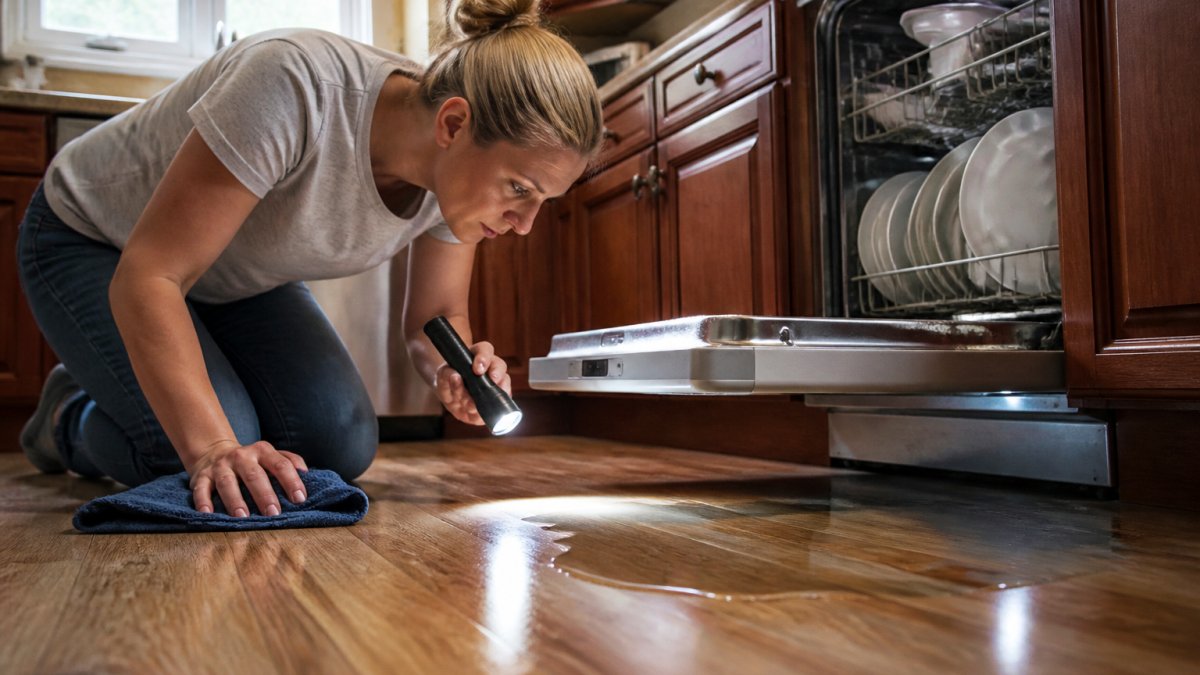
Protect the floor before you troubleshoot
Soak up standing water with towels, then place a shallow pan or a folded towel under the front edge to catch fresh drips. On hardwood or laminate, water that sits for even an hour can cup the seams and swell the subfloor. On tile, water migrates to the grout lines and can reach the subfloor or the unit below. A wet/dry shop vac is faster than towels for anything more than a puddle.
Use timing to narrow the cause
Once the area is dry, run one cycle and watch where the first drop appears. The timing of the leak is the fastest diagnostic tool you have, and most guides skip it:
| When the leak appears | Most likely cause | Where to look first |
|---|---|---|
| During fill (first few minutes) | Water inlet valve, fill hose, or float switch | Under the unit at the valve; check the float for debris |
| During wash (mid-cycle) | Door gasket, tub seam, or spray-arm deflection | Door edges and lower corners; check loading |
| During drain (end of cycle) | Drain hose, drain pump, or clamp | Under the sink at the disposal or drain connection |
| Constant drip, even when off | Supply line or inlet valve seat | Shutoff valve and line under the sink |
A leak during fill points at the inlet valve. A leak during drain points at the hose or pump. A leak that only shows up mid-wash usually means the door or tub. Note the timing before you pull any panels, because it tells you which panel to pull.
Know your model before you disassemble
Layouts vary widely by brand and model. Before removing the lower access panel or pulling the unit out, find the model and serial plate (usually on the inner door edge or the front frame) and look up the manual.
That last step matters more than most guides admit. Timing narrows the suspect list fast, and the manual tells you how to reach the suspect without breaking something else.
Dishwasher Leaking From the Bottom: Causes and Fixes
Water under the dishwasher usually comes from the pump, the drain hose connection, the tub, or the supply line. The challenge is that most of these sit behind the lower access panel or under the unit, so you need a safe way to look before you can diagnose.
Safe access before you look underneath
- Kill the breaker and close the supply valve (see the first section).
- Pull the bottom rack and remove the lower access panel (usually two to four screws along the bottom front). On many models the panel is a kick plate; on others it is a full toe-kick cover.
- Place a flashlight at floor level and look toward the center of the base. Do not reach into the base with the unit plugged in.
- If you need to pull the unit out, protect the floor with cardboard, disconnect the supply line and drain hose first, and have a pan ready. Most units slide out on leveling legs; some are hardwired and require the breaker off for the entire inspection.
Model layouts differ enough that the pump, valve, and float can sit in different corners of the base. Find the model plate and pull the service manual before you remove anything beyond the access panel.
The usual suspects, in rough order of frequency
- Pump seal: A worn seal lets water seep past the shaft. You will see drips near the center of the base, often only during wash. On many units the seal is a serviceable part; on some, the pump and seal are one assembly.
- Drain pump housing: Cracks or loose clamps let water escape during drain. Look for drips that start only at the end of the cycle.
- Clogged filter: A blocked filter backs water up until it finds a seam. Pull the filter basket, rinse it, and check the sump for food debris and grease.
A common mistake is replacing the pump when the real problem is a two-dollar clamp. Check the clamps and hoses before you buy parts.
Run a controlled leak test
After any repair, do not run a full load of dishes. Run a short rinse-only cycle with the access panel off and a flashlight on the base. Watch for the first drop at the repaired joint. If it stays dry through fill, wash, and drain, reinstall the panel and run one normal cycle with a towel under the front edge as a backstop.
Repair or replace: use age and tub condition
The repair-versus-replace call comes down to three factors: the age of the unit, the cost of the part relative to a new unit, and whether the tub itself is damaged.
| Leak source | Typical fix | Repair or replace? |
|---|---|---|
| Door gasket | Replace seal | Repair |
| Drain hose or clamp | Tighten or replace | Repair |
| Clogged filter | Clean | Repair |
| Pump seal | Replace seal or pump | Repair on newer units; weigh on units past mid-life |
| Cracked tub | Tub replacement | Usually replace; tub damage rarely pencils out |
| Control board (water damage) | Board replacement | Weigh against age and part availability |
A practical rule most technicians use: if the repair estimate approaches half the price of a comparable new unit and the appliance is past the middle of its expected service life, replacement is usually the better call. Our guide to appliance repair warranty coverage questions answered explains what usually counts, and these signs your dishwasher needs professional repair help you decide when to call.
Dishwasher Leaking From the Door: Seals, Hinges, and Loading
A dishwasher leaking from the door is the easiest leak to diagnose and the most common one we get called about.
Run your fingers along the rubber gasket. It should feel soft and sit flush against the tub. If it is stiff, cracked, or peeling away, water will slip past it during the wash cycle.
Other door-side causes:
- Door hinge: A bent or loose hinge keeps the door from closing square, so the gasket never seals.
- Furniture door panel: On panel-ready models, a misaligned panel can pull the door out of true.
- Loading: Overloading or blocking the spray arms sends water straight at the door.
Here is a loading rule: nothing tall in front of the door, and never let a utensil block the spray arm.
Dishwasher Drain Hose Leak: Tracking Down a Wet Connection
A dishwasher drain hose leak shows up as water pooling under the sink or at the back of the unit, often only during the drain cycle.
Check these connections:
- The clamp where the hose meets the pump
- The clamp at the sink drain or disposal inlet
- The hose itself for cracks or kinks
A blocked hose causes the same symptom. Food debris backs up, pressure builds, and water finds a weak joint.
Watch out: if the hose is not looped high under the sink, dirty drain water can siphon back into the dishwasher.
How to Stop a Dishwasher From Leaking: Repair vs. Replace
How to stop a dishwasher from leaking comes down to one question: is the fix worth more than the machine? A gasket, clamp, or hose is almost always worth repairing. A cracked tub or a failing control board on an old unit often is not.
Use this rule of thumb:
| Leak Source | Typical Fix | Repair or Replace? |
|---|---|---|
| Door gasket | Replace seal | Repair |
| Drain hose or clamp | Tighten or replace | Repair |
| Clogged filter | Clean | Repair |
| Pump seal | Replace seal or pump | Repair on newer units |
| Cracked tub | Tub replacement | Usually replace |
| Control board | Board replacement | Weigh against age |
If your unit is under an appliance warranty, check coverage before you touch anything. Our guide to appliance repair warranty coverage questions answered explains what usually counts.
Common Mistakes That Make a Leak Worse
The biggest mistake is running the dishwasher again to “see if it fixes itself.” It will not. Each cycle pushes more water into the cabinet, the floor, and the electrical parts.
Other missteps we see:
- Skipping the power shutoff. Pull the breaker first, every time.
- Over-tightening clamps. You can crack a plastic housing and create a new leak.
- Using the wrong gasket. Model-specific parts matter. A generic seal often will not fit right.
For a fuller list, read 7 common appliance repair mistakes homeowners make in 2026.
Book a Repair When the Leak Won’t Quit
Some leaks you can fix yourself. Others need a certified technician with the right parts and the right diagnostic tools.
At Appliance Specialists of Oklahoma, we send certified technicians to your home for on-site diagnostics.
Have questions before you book? Our FAQ page covers what to expect on a repair visit. Ready to get it handled? Contact us to schedule your on-site diagnostic.
Frequently Asked Questions
How do I get my dishwasher to stop leaking right now?
Turn off the dishwasher and shut off the water supply valve under the sink, then unplug the unit or flip its circuit breaker. Soak up standing water with towels and dry the floor so no one slips. Do not run the dishwasher again until you find the source. Most dishwasher leaking starts at the door gasket, drain hose, or pump seal, and a quick visual check of those three spots often points you to the problem before you call anyone.
Is it safe to run a dishwasher that is leaking?
No. Water near the electrical components and outlet under the counter creates a shock risk, and a slow leak can damage flooring and cabinets over time. Stop using the machine until the leak is fixed. If water is pooling near the power cord or you see any sparking, leave the breaker off and call a certified technician rather than testing it yourself.
What causes a dishwasher to leak from the bottom?
Bottom leaks usually come from a worn pump seal, a clogged filter that pushes water past the drain path, a loose drain hose connection, or a damaged water inlet valve. Overfilling from a faulty float switch can also send water out the bottom. Pull the lower rack and check the filter first, since a clogged filter is one of the most common and easiest fixes for dishwasher leaking from the bottom.
When should I call a professional for a leaking dishwasher?
Call a pro if the leak returns after you clean the filter and check the door seal, if water comes from under the tub where the pump sits, or if you are not comfortable shutting off power and water. A certified technician can diagnose the float switch, inlet valve, and pump seal in one visit and confirm whether a repair is worth the cost versus replacement.
A leaking dishwasher is a problem you can stop guessing about. Find the source, weigh the repair against the machine’s age, and call a pro when the leak keeps coming back. Get started with Appliance Specialists of Oklahoma and get your kitchen back to dry, quiet, and working the way it should.