Last Updated: October 28, 2026
Quick Summary
To find reliable appliance repair in Tulsa, verify the company’s legal name, insurance, and technician qualifications before booking, then ask for a written estimate and a repair workmanship warranty. Compare the quoted repair cost against replacement cost, especially if the appliance is past about 70 percent of its expected service life.
- Confirm the company’s legal business name matches the name on the estimate and invoice.
- Ask for a certificate of insurance before the technician visits your home.
- Request a written estimate before authorizing any work begins.
- Ask whether the diagnostic fee is applied to the repair cost if you proceed.
- Replacement usually makes more sense when repair costs more than half a new unit’s price.
Table of Contents
- Why Finding a Dependable Repair Service Matters
- Step 1: Check Qualifications and Certifications
- Step 2: Ask the Right Questions Before Booking
- Step 3: Understand Warranty Coverage Before the Visit
- Step 4: Get Written Estimates and Know the Average Cost of Appliance Repair
- Step 5: Spot Red Flags and Avoid Common Scams
- Repair or Replace: A Decision Framework for Tulsa Homeowners
- Booking Your Repair With Appliance Specialists of Oklahoma
- Frequently Asked Questions
Why Finding a Dependable Repair Service Matters
When a washer stops draining or a refrigerator starts warming up, the clock starts ticking. Food spoils, laundry piles up, and households in Tulsa, Broken Arrow, Jenks, and Bixby need someone reliable to show up. Finding a trustworthy appliance repair company can help you make an informed choice.
A careful search before booking can help you compare providers.
This guide walks through a practical process for vetting appliance repair services in the Tulsa area. It covers qualifications, the questions to ask, warranty coverage, written estimates, warning signs, and when replacement makes more sense than repair.
Step 1: Check Qualifications and Certifications
Before booking, ask what qualifications the technician has and how you can verify them.
The pre-booking vetting checklist
Consider these questions before you agree to a visit.
- Business identity. Ask for the company’s legal business name and confirm it matches the name on the estimate, invoice, and any contract. A company operating under a different name than the one it advertises is a warning sign.
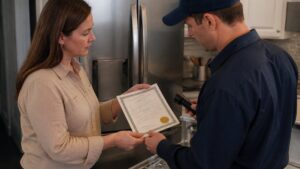
- Insurance. Ask whether the company carries insurance and request documentation.
- Licensing where applicable. Ask the company what licensing or credentials apply to its work and who issues them.
- Manufacturer authorization. If your appliance is under a manufacturer warranty, check the warranty terms before arranging service.
- Technician qualifications. Ask what qualifications the technician has and how you can verify them.
- Local track record. Ask for the company’s business address and how long it has served the area.
Keep records of the information you receive from the company.
Questions that separate qualified from vague
You can ask a technician:
- Which manufacturer training programs have you completed, and for which brands?
- Who issues the licensing that applies to your work, and what is your license or registration number?
- Can you provide a certificate of insurance before the visit?
- How long has the company serviced appliances in this metro area, and what is your physical business address?
- What warranty do you offer on your own workmanship, and what does it exclude?
Ask for specifics about a company’s credentials before booking.
Step 2: Ask the Right Questions Before Booking
Before you agree to a visit, consider asking a few questions.
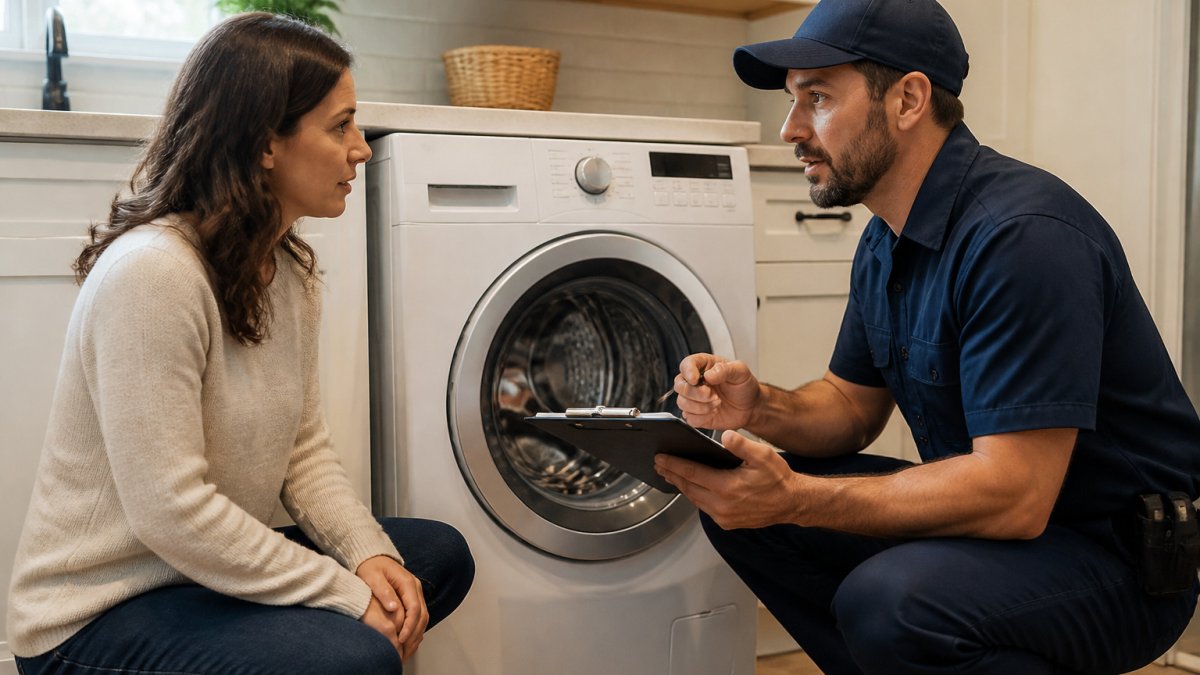
Useful questions to ask a technician include:
- What is your diagnostic fee, and is it applied to the repair cost if I proceed?
- Will you give me a written estimate before any work begins?
- What is your arrival window, and what happens if you cannot make it?
- Do you stock common parts, or will the repair require a second visit?
- Do you work with my appliance’s warranty?
During the call, ask about pricing and the company’s process.
Step 3: Understand Warranty Coverage Before the Visit
Check your warranty terms to understand any requirements for repair service and coverage.
Check your warranty paperwork or the manufacturer’s website for the coverage terms.
Two types of warranty protection matter here:
- Manufacturer warranties cover defects in parts and sometimes labor for a set period.
- Repair workmanship warranties cover the technician’s own labor, usually for a stated number of days or months.
Ask every provider to explain both. A written guarantee on parts and labor gives you recourse if the problem returns. For more detail on common coverage questions, see our guide on appliance repair warranty coverage questions answered.
Step 4: Get Written Estimates and Know the Average Cost of Appliance Repair
Ask for a written estimate before authorizing work.
Ask for a quote for the specific repair you need.
Ask whether a diagnostic fee applies and how it is handled.
A quick reference for the repair-versus-replace decision, using the figures the guide already gives.
| Appliance | Typical service life | Replacement threshold |
|---|---|---|
| Refrigerator | 10 to 15 years | Past roughly 70% of life |
| Washer | 8 to 12 years | Past roughly 70% of life |
| Dryer | 10 to 13 years | Past roughly 70% of life |
| Dishwasher | 8 to 12 years | Past roughly 70% of life |
| Oven or range | 12 to 15 years | Past roughly 70% of life |
| Microwave | 7 to 10 years | Past roughly 70% of life |
Step 5: Spot Red Flags and Avoid Common Scams
When comparing providers, consider asking about:
- Offer a suspiciously low advertised price and then add large fees on arrival
- Refuse to provide a written estimate or invoice
- Insist that a part must be replaced without showing you the problem
- Pressure you to pay in cash or to sign before you have reviewed the paperwork
- Have no verifiable business address or local phone number
You can ask the technician to explain the issue and the proposed repair.
Repair or Replace: A Decision Framework for Tulsa Homeowners
Whether to repair or replace an appliance depends on its condition and the costs involved.
Step 1: Estimate where the appliance is in its service life
Use typical service-life ranges as a benchmark, then adjust for how hard the appliance has worked. These are common industry planning figures, not guarantees:
- Refrigerator: roughly 10 to 15 years
- Washer: roughly 8 to 12 years
- Dryer: roughly 10 to 13 years
- Dishwasher: roughly 8 to 12 years
- Oven or range: roughly 12 to 15 years
- Microwave: roughly 7 to 10 years
If the appliance is past roughly 70 percent of its expected service life, weigh repair more carefully. A repair that costs a large share of a replacement on an aging unit often does not pay back.
Step 2: Compare repair cost to replacement cost
A simple rule many technicians use: if the repair costs more than half the price of a comparable new appliance, and the unit is already past the midpoint of its service life, replacement usually wins. If the repair is well under half the replacement price and the unit is young, repair usually wins.
Run it as a ratio:
- Repair-to-replace ratio = quoted repair cost ÷ replacement cost
- Below about 0.5 on a young appliance: repair is usually the better call.
- Above about 0.5 on an aging appliance: replacement deserves serious consideration.
Step 3: Work through a concrete example
Suppose your 9-year-old refrigerator needs a sealed-system repair quoted at $650, and a comparable new refrigerator costs about $1,200. The repair-to-replace ratio is roughly 0.54, and the unit is near the end of its typical service life. That combination points toward replacement. Now suppose the same refrigerator needs a $180 drain-pump repair. The ratio is about 0.15, the fault is isolated, and repair is the clear choice.
Step 4: Factor in repeat failures and efficiency
- Repeat failures. If the same appliance has needed two or more repairs in the past two years, the pattern matters more than any single quote. Repeated failures often signal that other components are near the end of their life.
- Efficiency. Older refrigerators, washers, and dishwashers can use noticeably more energy and water than current models. A repair that keeps an inefficient unit running may cost more over time than the repair price suggests.
- Parts availability. Ask whether the needed part is still manufactured and how long sourcing will take. A repair that requires a hard-to-find part and a second visit changes the math.
Ask the technician to explain the recommendation and the reasoning behind it.
Step 5: Get the numbers in writing before deciding
Ask for a quote for the repair before deciding.
Booking Your Repair With Appliance Specialists of Oklahoma
Appliance Specialists of Oklahoma provides residential repair for refrigerators, washers, dryers, dishwashers, ovens, and microwaves across the Tulsa metro area. The team performs on-site diagnostics in your home. Most repairs are completed within three days.
To learn what services are offered, visit our service offerings. Before scheduling, confirm that your address falls within our service area. When you are ready to ask about a quote, use our contact page.
Frequently Asked Questions
How do I know if an appliance repair company is licensed and insured?
Ask the company for its business name and request information about its credentials before booking.
Do appliance repair companies offer warranties on their work?
Check your appliance warranty terms before arranging service.
Is it worth repairing an old appliance or should I replace it?
Compare the repair estimate with the cost of replacement before deciding.
How can I verify the reputation of a local repair business?
Ask the business for information about its services and how to reach it.